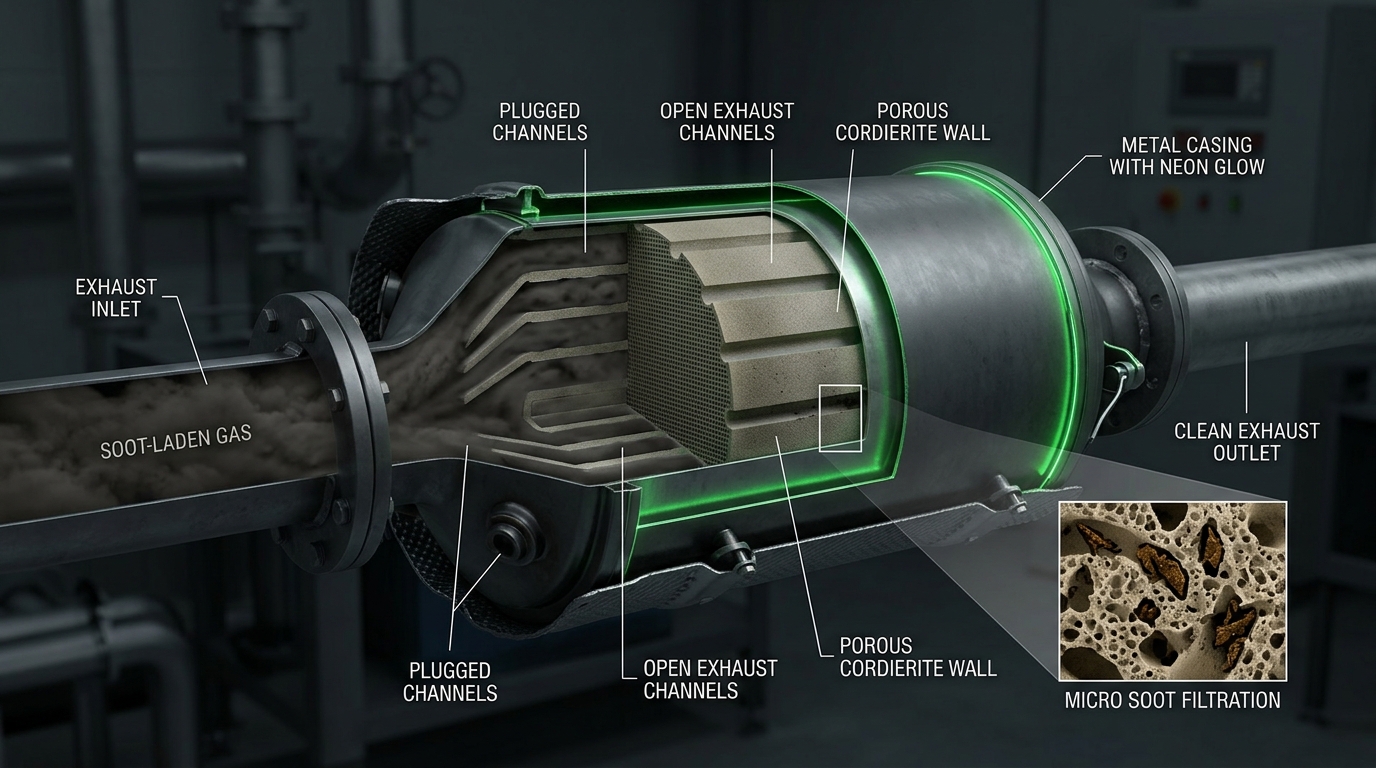
For heavy-duty commercial haulers, delivery fleets, and diesel equipment operators across Ontario, the Diesel Particulate Filter (DPF) is one of the most critical—and frequently misunderstood—components in the modern exhaust aftertreatment system. Introduced across North America to meet stringent Canadian Environmental Protection Act and US EPA standards, the DPF plays a pivotal role in preventing toxic particulate matter from venting directly into the atmosphere.
1. What Is a Diesel Particulate Filter (DPF)?
A Diesel Particulate Filter is a specialized physical filtration canister installed in the exhaust line downstream of the engine turbocharger and the Diesel Oxidation Catalyst (DOC). Unlike conventional flow-through automotive mufflers that allow exhaust to stream directly through unobstructed baffles, a DPF utilizes a porous ceramic monolith substrate—commonly fabricated from cordierite or silicon carbide (SiC)—structured in a wall-flow honeycomb arrangement.
In this honeycomb matrix, hundreds of parallel micro-channels run longitudinally through the canister. Crucially, alternating channels are plugged at opposite ends in a checkerboard pattern. Raw exhaust gas enters an open inlet channel, but because the opposite end is hermetically blocked, the exhaust gas is forced through microscopic pores in the cellular ceramic walls to escape through an adjacent channel that is open to the tailpipe. As exhaust passes through these porous cell walls, suspended particulate matter—composed of solid carbon agglomerates, unburned heavy hydrocarbons, and metallic lubricant additives—is physically trapped on the inlet channel walls.
2. The Chemistry of Combustion: Why Modern Engines Need DPFs
Diesel combustion occurs under intense compression ratios (often 16:1 to 18:1) and heterogeneous air-fuel mixtures. When diesel is atomized into the hot combustion bowl, localized oxygen-deficient zones generate microscopic carbon particles known as particulate matter (PM). If released into the atmosphere, fine particulates (PM2.5 and PM10) present significant respiratory hazards and contribute to urban smog across dense transit arteries such as the Highway 401 corridor.
Modern commercial diesel engines (such as Detroit DD15, Cummins X15, Volvo D13, and PACCAR MX-13) rely on wall-flow DPFs to capture more than 98% of particulate emissions by mass. The filter effectively transforms what would otherwise be dark, carbon-laden exhaust smoke into clear, virtually odorless exhaust output.
3. Understanding Regeneration: Passive vs. Active Cycles
Because the DPF physically stores soot within its cell walls, the filter would choke the engine with excessive exhaust backpressure within a single day of driving if it did not possess an internal thermal self-cleaning mechanism known as regeneration. Regeneration is the thermal oxidation process that combusts trapped carbon soot into harmless carbon dioxide (CO2) gas.
Passive Regeneration
Occurs automatically when the truck operates under sustained highway loads at operating exhaust temperatures between 300°C and 450°C. In this thermal window, nitrogen dioxide (NO2) generated across the upstream DOC acts as a chemical catalyst, oxidizing carbon soot continuously without extra fuel injection or driver intervention.
Active Regeneration
Initiated automatically by the engine control module (ECM) when differential pressure sensors detect high soot loading during low-load or stop-and-go driving. The ECM activates a dedicated hydrocarbon doser (7th injector) in the exhaust stream, creating an exothermic catalytic reaction in the DOC that raises DPF internal core temperatures to 550°C–650°C, incinerating the soot.
4. Soot vs. Incombustible Ash: The Critical Difference
One of the most dangerous misconceptions among truck operators is the belief that thermal regeneration cleans the filter completely. Regeneration only burns carbon soot. It cannot destroy incombustible ash.
Ash originates from non-combustible metallic detergents, anti-wear compounds, and friction modifiers present in heavy-duty diesel engine oil (such as zinc dialkyldithiophosphate / ZDDP, calcium sulfonate, and phosphorus), alongside trace impurities in diesel fuel. When small quantities of lubricating oil slip past turbocharger oil seals, valve guides, or piston scraper rings, the combustible oil base burns off, leaving behind solid metal oxide and sulfate ash deposits (primarily calcium sulfate and zinc phosphate).
This dense ash slowly accumulates at the rear plugs of the inlet channels. Over 200,000 to 400,000 kilometres of operation, compacted ash can consume 50% or more of the filter’s internal storage capacity. Because ash is chemically inert and completely non-combustible, no amount of forced parked regeneration can burn it away. The only remedy is off-vehicle pneumatic pulse and pneumatic/ultrasonic cleaning at a specialized workshop restoration facility.
5. How Clogged Filters Damage Your Engine and Turbocharger
When a DPF becomes packed with ash and soot, exhaust gases encounter severe resistance. This produces elevated exhaust manifold backpressure that ripples upstream through the entire powertrain:
- warning Turbocharger Thrust Bearing Failure: Excessive backpressure pushes exhaust turbine wheels axially against internal thrust bearings, causing oil seal leakage, shaft play, and catastrophic turbocharger failure.
- warning Severe Fuel Consumption Increase: Engines operating against restricted exhaust must perform significant pumping work to expel exhaust gas, consuming 5% to 15% more diesel fuel per kilometre.
- warning Thermal Substrate Sintering & Melting: When an ash-packed DPF attempts an active regeneration, the localized concentration of soot can generate runaway temperatures exceeding 1,000°C, permanently cracking or melting the ceramic substrate.
Frequently Asked Questions
How often does a heavy-duty DPF need professional workshop cleaning?
Most engine manufacturers (Detroit Diesel, Cummins, Volvo, PACCAR) recommend professional off-truck pneumatic ash removal every 250,000 to 350,000 kilometres (or 4,000–5,000 engine hours). Trucks engaged in high-idle regional delivery or municipal stop-and-go duty cycles should be serviced earlier, typically around 200,000 kilometres.
Can chemical fuel additives clean an ash-packed DPF?
No. Fuel-borne catalysts can temporarily reduce the ignition temperature of carbon soot, but they have zero effect on metallic ash. In fact, many unapproved aftermarket additives introduce additional non-combustible metallic elements that accelerate ash loading and foul the expensive SCR catalyst downstream.
How do JTECH DPF technicians verify filter health?
At our Kitchener emissions centre, we subject every filter to calibrated flow bench differential pressure testing before and after cleaning. We measure airflow in cubic feet per minute (CFM), conduct optical pin-checks and internal borescopic inspections for cell integrity, and provide certified flow recovery reports verifying that backpressure is restored to OEM specifications.
Need Professional DPF Testing or Cleaning in Kitchener?
Whether you require emergency on-site mobile assistance or comprehensive in-shop pneumatic flow restoration, the technicians at JTECH DPF in Kitchener, Ontario are equipped with state-of-the-art testing equipment.
Contact JTECH DPF Specialists →