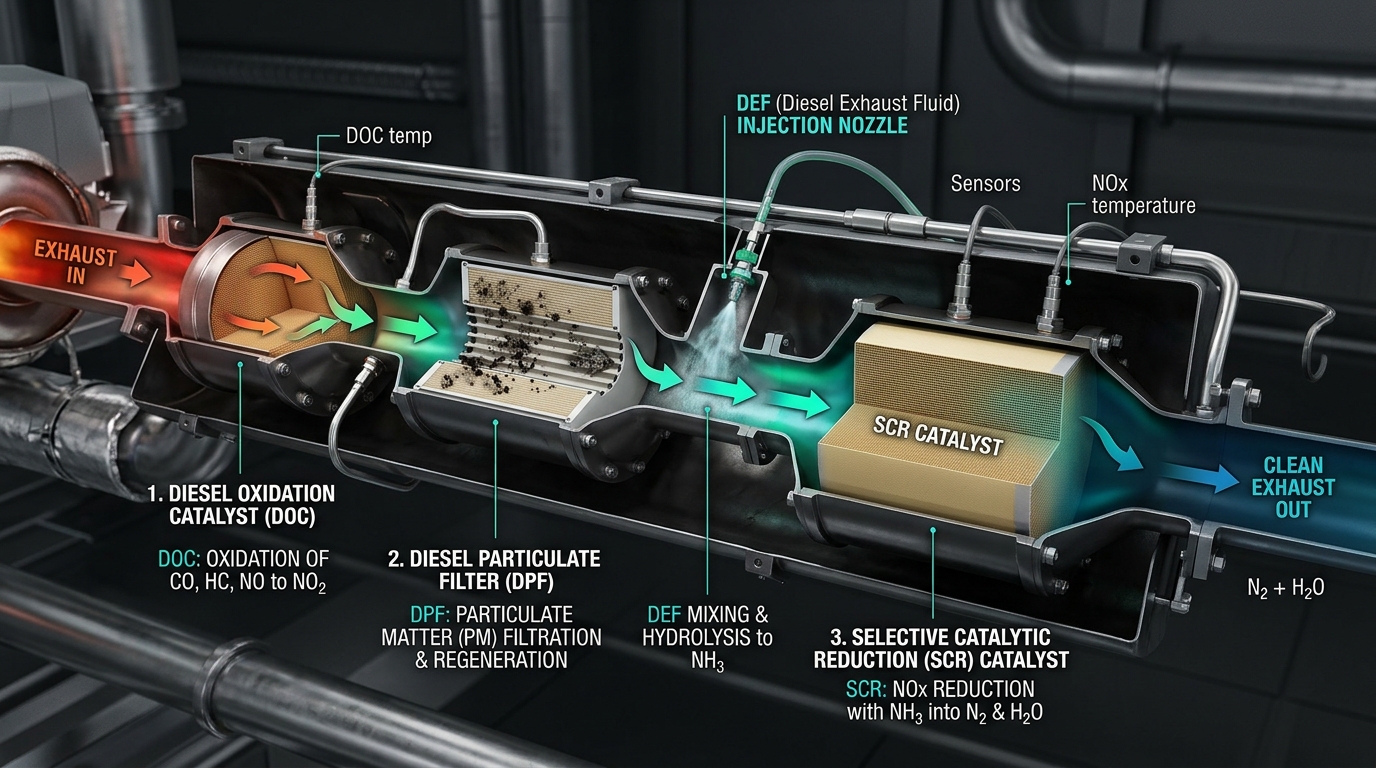
To the untrained eye, a modern heavy-duty commercial truck exhaust aftertreatment assembly resembles a large, cumbersome stainless steel canister mounted beneath the passenger-side cab steps. In reality, this "one-box" or modular architecture houses three distinct, chemically sophisticated emissions devices: the Diesel Oxidation Catalyst (DOC), the Diesel Particulate Filter (DPF), and the Selective Catalytic Reduction (SCR) catalyst.
Understanding the specialized role of each component—and the critical thermodynamic interdependencies between them—is essential for every commercial driver, fleet manager, and heavy mechanic operating in Ontario.
1. Component Breakdown: Three Catalysts, Three Missions
1. Diesel Oxidation Catalyst (DOC)
Architecture: Flow-through ceramic honeycomb coated with precious metal washcoats (platinum and palladium). Unlike a DPF, all channels are open from end to end.
Chemical Role: The DOC is the thermal and chemical workhorse of the aftertreatment system. It oxidizes unburned hydrocarbons (HC) and toxic carbon monoxide (CO) into harmless carbon dioxide (CO2) and water vapour (H2O). Crucially, the DOC converts raw nitric oxide (NO) in the exhaust into nitrogen dioxide (NO2). This NO2 acts as an indispensable chemical catalyst that enables continuous passive soot oxidation in the downstream DPF at moderate driving temperatures.
Thermal Lift: When active regeneration is commanded, atomized diesel injected by the hydrocarbon doser reaches the DOC. The catalytic reaction produces an intense exothermic burn, elevating exhaust temperatures from 250°C to 600°C to incinerate soot in the DPF.
2. Diesel Particulate Filter (DPF)
Architecture: Wall-flow cellular monolith (cordierite or silicon carbide) with alternating plugged channels forcing exhaust through micro-porous walls.
Physical Role: While the DOC operates chemically on gases, the DPF operates mechanically on solids. It captures more than 98% of airborne particulate matter, soot agglomerates, and non-combustible metallic engine oil ash. It stores these trapped materials until passive/active regeneration burns off the carbon soot, while incombustible ash remains permanently until purged during off-vehicle workshop servicing.
3. Selective Catalytic Reduction (SCR)
Architecture: High-volume ceramic flow-through substrate coated with base metal oxides (copper or iron zeolites), positioned downstream of the DPF.
Chemical Role: The SCR system is dedicated to eliminating toxic oxides of nitrogen (NOx), a primary cause of ground-level smog. Upstream of the SCR brick, a precision doser injects Diesel Exhaust Fluid (DEF / 32.5% high-purity aqueous urea) into the exhaust stream. In the hot exhaust, urea thermolyzes into ammonia (NH3) and isocyanic acid. Inside the SCR catalyst matrix, the ammonia reacts chemically with NOx molecules to convert them into completely benign nitrogen gas (N2) and water vapour (H2O).
2. The Cascade Effect: How One Failing Component Destroys the Others
Because exhaust gas flows sequentially through DOC → DPF → SCR, a failure in an upstream component inevitably triggers catastrophic damage downstream:
- error DOC Face Deactivation Destroys DPF: If the DOC becomes contaminated by silicone, zinc, or engine coolant, it loses the catalytic ability to generate heat. The DPF cannot reach active regeneration temperatures (550°C), resulting in permanent soot packing and rapid engine derate.
- error Cracked DPF Destroys the $7,000+ SCR Catalyst: If a DPF cracks due to thermal shock or runaway regeneration, uncaptured black soot streams directly into the delicate zeolite pores of the downstream SCR brick. This permanently poisons the catalyst, throwing irreversible DEF dosing efficiency fault codes (SPN 4364 / FMI 18) that require replacing the entire aftertreatment assembly.
- error DEF Doser Failure Causes Upstream Backpressure: If DEF dosing is excessive or incomplete, crystalline urea deposits accumulate into solid rock-like mounds at the SCR inlet face, choking the exhaust and mimicking DPF backpressure.
3. Maintenance Protocol for the Complete Aftertreatment System
To ensure long-term reliability and avoid five-figure repair bills, commercial operators should follow a holistic emissions maintenance strategy:
- Perform Bi-Annual Borescopic Inspections: Inspect the DOC inlet face for oil/coolant glaze and the DPF outlet face for black soot blow-by cracks.
- Schedule Professional Off-Vehicle DPF Cleaning: Clean DPFs every 250,000 to 350,000 kilometres at a specialized facility like JTECH DPF to remove ash before backpressure spikes.
- Flush and Calibrate the DEF Dosing System: Inspect DEF doser injector nozzles for urea crystallization and test tank heating circuits ahead of Ontario winter freezes.
Frequently Asked Questions
Can a DOC be cleaned at the same time as a DPF?
Yes. During workshop DPF servicing at JTECH DPF, we inspect and de-coke the DOC using high-temperature thermal ovens and low-pressure pneumatic flushing to remove hydrocarbon deposits and restore precious metal catalytic activity.
What does an SCR efficiency code mean?
An SCR efficiency code (such as Cummins SPN 4364 or Detroit SPN 3216) indicates that NOx conversion rates between inlet and outlet NOx sensors have fallen below regulatory minimums. Common causes include DEF quality degradation, crystallized doser nozzles, faulty NOx sensors, or soot poisoning from an upstream cracked DPF.
Why does JTECH DPF test the entire aftertreatment system?
Because aftertreatment components operate in a continuous thermodynamic chain, simply cleaning a DPF without verifying DOC catalytic health or SCR DEF dosing efficiency guarantees recurring customer downtime. We diagnose the entire system to deliver lasting reliability.
Comprehensive Aftertreatment Care in Kitchener, ON
Protect your heavy-duty powertrain with thorough aftertreatment diagnostics, DOC restoration, and certified DPF pneumatic cleaning at JTECH DPF.
Speak With Our Technical Team →