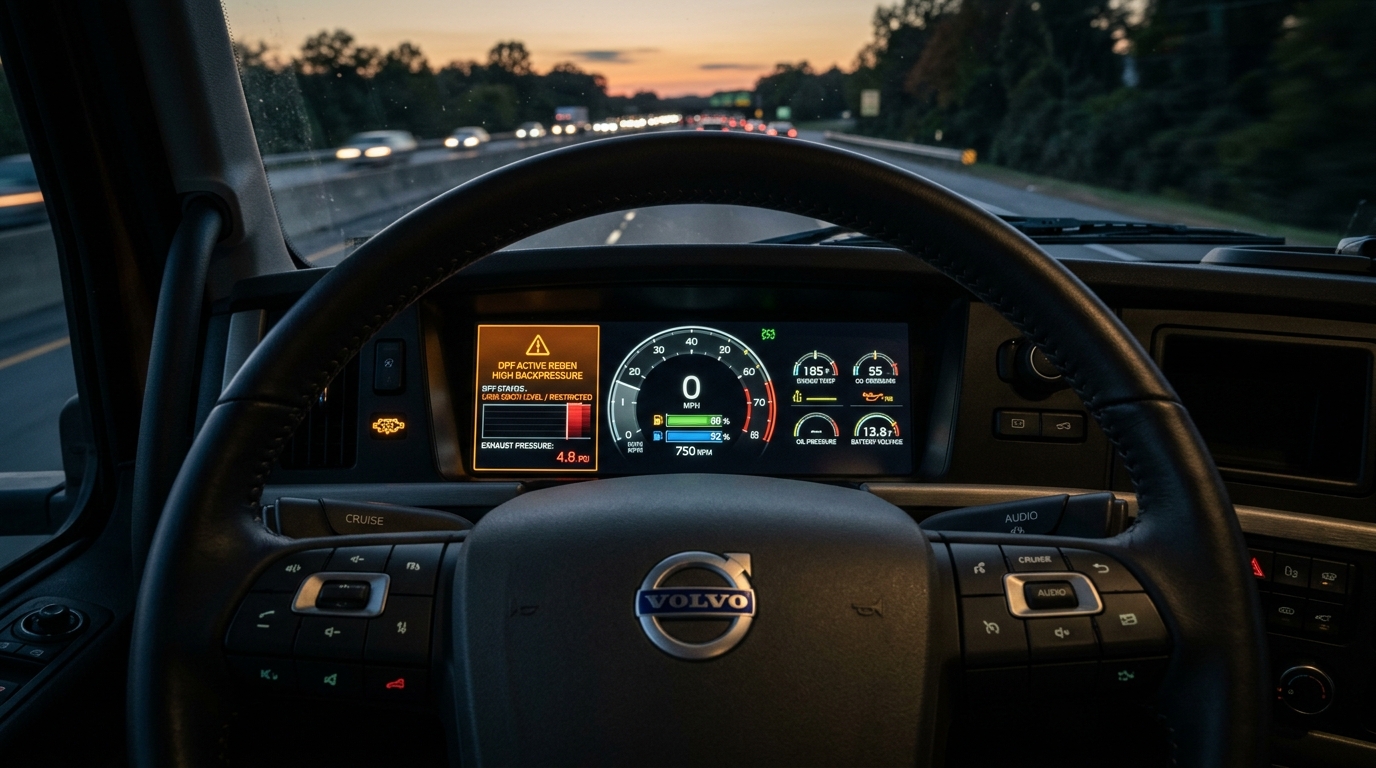
In the commercial trucking and heavy transport industry, an unexpected roadside breakdown is one of the most costly events an owner-operator or fleet manager can experience. Exhaust aftertreatment systems are designed to operate unobtrusively, but when a Diesel Particulate Filter (DPF) becomes restricted by soot and incombustible ash, the vehicle provides distinct operational warnings before escalating into a crippling engine derate.
1. Persistent Solid or Flashing DPF Dashboard Indicator
The most direct indicator of aftertreatment distress is the instrument cluster DPF lamp. Commercial trucks utilize a standardized multi-stage alert sequence:
- Solid Amber DPF Lamp: Signifies soot loading has reached approximately 80% to 90%. The ECM is requesting a highway driving cycle to enable passive regeneration or an immediate parked active regeneration.
- Flashing Amber DPF Lamp: Indicates soot accumulation has exceeded 100% of normal thresholds. A parked regeneration must be initiated immediately before engine torque is curtailed.
- Flashing DPF Lamp + Check Engine / Stop Engine Alert: The filter is severely plugged. The ECM triggers an emergency power derate to protect turbochargers and exhaust valves from destructive backpressure. At this stage, on-truck parked regens are often locked out by the software to avoid exhaust fires.
2. Abnormally Frequent Active Regeneration Cycles
Under typical long-haul duty cycles, a healthy heavy-duty truck regenerates every 1,200 to 2,500 kilometres. If your truck begins commanding active regenerations every 200 to 500 kilometres—or several times during a single working shift—the filter's usable physical volume has been compromised.
This phenomenon almost always points to severe incombustible ash packing. Because non-combustible lubricant ash occupies the bottom 40% to 60% of the channel capacity, the remaining open channel volume fills rapidly with soot, triggering frequent differential pressure sensor trips.
3. Noticeable Engine Sluggishness and Power Derate
When exhaust gases cannot pass freely through the ceramic substrate, severe backpressure accumulates in the exhaust manifold. The engine must expend extra mechanical work simply to expel burnt gases from the combustion chambers—a condition known as parasitic pumping loss. Drivers will notice sluggish acceleration from dead stops, difficulty pulling loaded trailers up highway grades, and poor throttle response.
4. Sharply Escalating Fuel Consumption
A choked DPF affects fuel economy in two distinct ways. First, elevated backpressure forces the cylinders to work harder during the exhaust stroke, wasting fuel energy. Second, when the ECM continuously detects elevated delta-P readings, it initiates repeated active regenerations, commanding the hydrocarbon doser to inject substantial volumes of diesel fuel directly into the exhaust stream to heat the DOC. Commercial fleets often notice a 5% to 15% increase in total fuel burn when DPFs are overdue for cleaning.
5. Engine Crankcase Oil Dilution and Rising Dipstick Levels
One of the most dangerous hidden side effects of frequent active regenerations is crankcase oil dilution. During active regeneration cycles that use in-cylinder late post-injection to supply unburned fuel to the exhaust, atomized diesel washes down the cylinder liner walls past piston compression rings, entering the engine oil pan.
If you inspect your dipstick during pre-trip inspections and notice oil levels rising above the full mark, or if the oil smells strongly of raw diesel fuel, unburned fuel is diluting your lubricant. Diluted oil loses its hydrodynamic film strength, risking rod bearing scoring, camshaft wiping, and catastrophic crankshaft failure.
6. Acrid Exhaust Odours and Soot Seepage at Exhaust V-Band Clamps
A healthy aftertreatment canister is completely gas-tight. When internal backpressure spikes to extreme levels, exhaust gases seek alternative escape paths. Operators frequently observe fine black soot escaping around turbo outlet elbow connections, bellows flex pipes, and aftertreatment canister V-band clamps. Additionally, prolonged thermal dosing can produce pungent, burning acrid smells in the cab during idling.
7. High Differential Pressure Readings During Diagnostics
During electronic diagnostic hookups using OEM software (Detroit Diagnostic Link, Cummins Insite, Volvo Tech Tool), technicians measure differential pressure (delta-P) in kilopascals (kPa) or inches of water across the DPF canister. While a freshly cleaned filter typically displays 0.5 to 1.5 kPa at engine idle, a saturated filter will register 4.0 to 10+ kPa, signaling dangerous restriction.
Frequently Asked Questions
Can I force consecutive parked regenerations if the DPF light stays on?
No. Forcing repeated parked regenerations when a filter is severely loaded with carbon and ash is a leading cause of thermal runaway. Concentrated localized heat can exceed 1,000°C, melting the internal honeycomb or causing ceramic thermal shock cracks that permanently destroy the filter.
Can mobile DPF cleaning help if my truck is already derated?
Yes. JTECH DPF offers mobile on-site DPF cleaning across Kitchener and Waterloo Region. Our mobile diagnostic unit comes directly to your yard or breakdown location, reads live ECM fault codes, evaluates differential pressure, and performs on-truck pneumatic purging and reset procedures to clear derates without towing fees.
Will highway driving clear a solid DPF warning light?
If the light is a steady amber and the filter is only loaded with soft soot, 45 to 60 minutes of uninterrupted highway driving at steady RPM can generate sufficient exhaust heat (350°C+) to trigger passive regeneration. However, if the warning is flashing, or if the restriction is caused by accumulated ash, highway driving will not resolve the issue.
Diagnose Warning Signs with JTECH DPF in Kitchener
Do not wait until a minor dashboard warning turns into an expensive Highway 401 tow bill. Contact Jasmeet and the technical team at JTECH DPF for rapid differential pressure verification and certified filter restoration.
Book DPF Diagnostics Today →