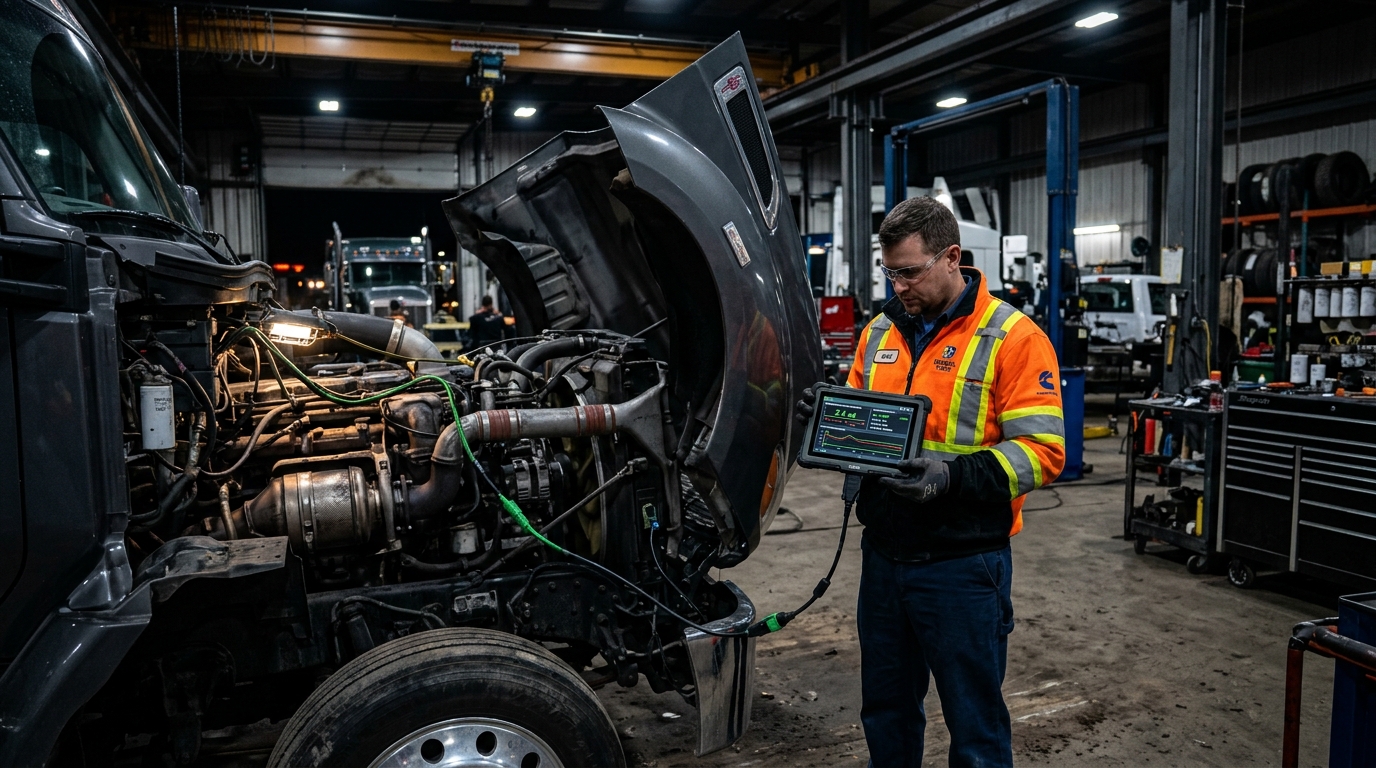
One of the most frustrating aftertreatment symptoms reported by commercial truck drivers and fleet maintenance supervisors across Ontario is an engine that constantly demands active regenerations. When a heavy-duty diesel truck begins triggering regeneration cycles every few hours or under 500 kilometres, operating efficiency drops, fuel consumption spikes, and the risk of driver fatigue and roadside derate increases dramatically.
At JTECH DPF in Kitchener, our diagnostic philosophy is grounded in an essential engineering truth: a frequently regenerating DPF is almost always a symptom of an upstream engine or aftertreatment malfunction, not the primary cause. Below, we analyze the seven definitive root causes behind rapid DPF regeneration cycles.
1. Severe Incombustible Ash Compaction
The most common cause of frequent regenerations on high-mileage trucks (over 250,000 kilometres) is physical ash accumulation. As discussed in our DPF technology guide, thermal regeneration combusts carbon soot into carbon dioxide gas, but it cannot incinerate non-combustible metallic lubricant ash.
When ash fills 50% or more of the inlet channel volume, the remaining space available for soot storage shrinks dramatically. As the engine produces normal quantities of soot during hauling, the diminished storage space fills within hours, rapidly elevating differential pressure across the canister and causing the ECM to trigger active regenerations repeatedly.
2. Faulty or Leaking Common-Rail Fuel Injectors
Modern high-pressure common rail (HPCR) fuel injectors operate at pressures exceeding 30,000 PSI. If an injector nozzle tip develops microscopic erosion, carbon deposits, or internal solenoid valve leakage, it fails to achieve proper fuel atomization. Instead of creating a fine, combustible mist, the damaged injector drips raw liquid diesel into the cylinder bowl.
This localized over-fueling produces incomplete combustion, generating colossal volumes of black carbon soot that overpower the DPF canister in a fraction of normal operating time. Technicians can identify this by running electronic cylinder cutout and smooth running balance tests on OEM diagnostic software.
3. Turbo Boost Leaks and Cracked Charge Air Coolers (CAC)
Diesel combustion requires substantial excess air mass (high lambda) for complete burning. If your charge air cooler develops road-debris punctures, or if silicone turbo boots split, boost pressure drops under load.
When boost leaks reduce cylinder air density while the ECM commands full fueling to maintain highway speeds, the engine runs rich. The resulting air-starved combustion produces continuous dense soot that rapidly chokes the DPF matrix. Pressure testing the intake tract from turbo outlet to intake manifold is a mandatory step in our diagnostic procedure at JTECH DPF.
4. Defective Differential Pressure (Delta-P) Sensor or Blocked Tubes
The ECM does not visually inspect the DPF; it relies on a differential pressure sensor connected to stainless steel reference tubes tapped before and after the filter canister.
If moisture, soot, or road corrosion plugs the sensor tubes, or if the sensor’s internal piezoresistive diaphragm drifts out of calibration, the sensor reports falsely elevated pressure drops to the ECM. Believing the filter is choked with soot, the ECM initiates active regenerations even when the filter core is relatively clean.
5. Stuck or Leaking Exhaust Gas Recirculation (EGR) Valves
The EGR system meters cooled exhaust gas back into the intake manifold to reduce combustion peak temperatures and lower NOx formation. However, if the EGR valve sticks open due to carbon deposits, or if the EGR cooler leaks, excessive exhaust gas displaces fresh oxygen in the cylinders.
Oxygen starvation severely impairs combustion, generating massive quantities of wet carbon soot that saturate the DPF within hours of driving.
6. Degraded Diesel Oxidation Catalyst (DOC) Face
The upstream DOC is responsible for converting exhaust hydrocarbon dosing into thermal energy. If the DOC face becomes masked by phosphorus or thermal sintering, it cannot reach the 550°C to 600°C temperatures necessary to oxidize DPF soot completely. The ECM observes that active regeneration cycles fail to lower differential pressure, leading to repeated, aborted regeneration attempts.
7. Excessive Cold-Weather Idling in Ontario Winters
During harsh Southern and Northern Ontario winters, commercial operators frequently idle engines overnight to maintain cab climate. Extended idling at low combustion temperatures produces "wet stacking"—unburned fuel and carbon deposits that coat exhaust walls and plug aftertreatment channels without generating the exhaust heat needed for passive burnoff.
Frequently Asked Questions
Can continuing to drive with frequent regens ruin my engine?
Yes. Continuous active regenerations introduce substantial raw diesel fuel into the cylinders during the exhaust stroke. This fuel washes down cylinder walls, dilutes the engine oil, and destroys the lubricating film protecting crankshaft bearings. It also creates extreme thermal stress that can crack turbocharger housings.
How do JTECH DPF technicians diagnose frequent regenerations?
At JTECH DPF in Kitchener, we connect OEM diagnostic hardware to analyze injector balance rates, verify delta-P sensor voltages against physical mechanical gauges, pressure-test charge air coolers, and perform borescopic inspections of DOC and DPF faces to isolate the root cause before cleaning.
Will mobile on-site cleaning solve frequent regens?
If the frequent regenerations are caused by recent upstream soot loading or differential pressure sensor faults, our mobile DPF cleaning unit can test and reset systems directly at your terminal. If the canister is compacted with high-mileage ash, we arrange seamless workshop de-mounting and pneumatic restoration at our Kitchener facility.
Stop Guessing: Diagnose Frequent Regens in Kitchener
Do not replace costly aftertreatment components without verifying the underlying cause. Contact Jasmeet and the specialized emissions technicians at JTECH DPF for comprehensive troubleshooting.
Book Emissions Diagnostics →