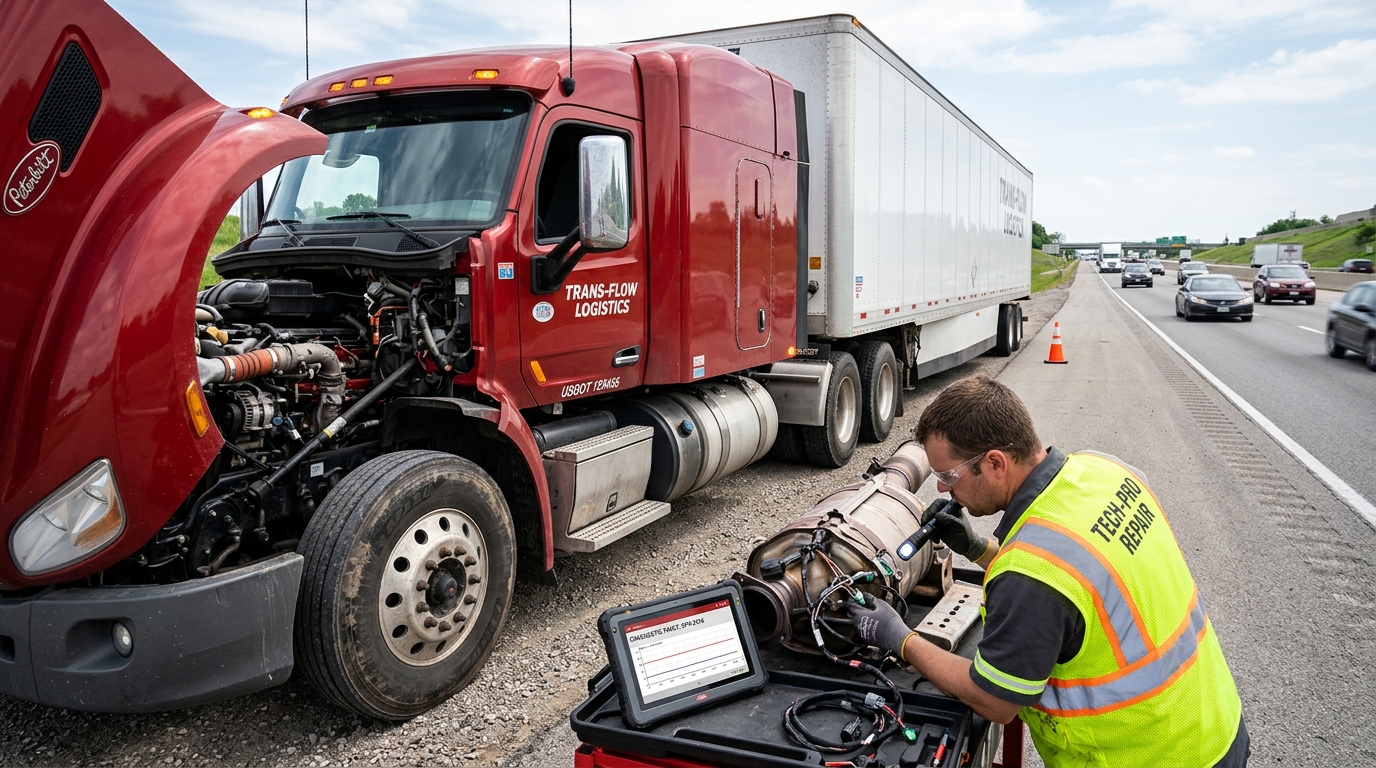
In the freight logistics and commercial transport sector, a truck is only generating revenue when its wheels are turning on the highway. When an instrument cluster flashes an aftertreatment derate code and limits a commercial power unit to 8 km/h on the side of Highway 401, the immediate financial shock extends far beyond the price of mechanical repair.
Unscheduled DPF failures trigger an expensive chain reaction of direct and indirect expenses. Understanding the true financial anatomy of an aftertreatment breakdown underscores why planned, proactive maintenance is the only sound financial strategy.
1. The Direct Costs of a Roadside DPF Breakdown
Emergency Heavy-Duty Towing
$800 – $2,000+ CAD
Class 8 tandem-axle heavy-duty towing in Southern Ontario carries hefty hook fees and mileage surcharges. Moving a disabled tractor-trailer combination off a major 400-series highway to a certified repair facility routinely exceeds $1,000 CAD.
Emergency Dealership Shop Rates
$180 – $250 / hour
Dealership service departments charge premium labor rates for emergency walk-in diagnostic triage. More critically, dealership bay queues often mean the truck sits idle for 3 to 7 business days before a technician even connects a scan tool.
2. The Hidden Indirect Costs: Lost Freight Revenue and SLA Penalties
While direct repair invoices are easy to track, the indirect downtime costs often deal the most devastating blow to an operating balance sheet:
- trending_down Lost Daily Revenue ($1,200 – $2,200 CAD per day): An idle commercial truck continues to incur fixed capital depreciation, insurance amortization, and lease payments without generating gross freight billings. Three days in a dealership bay equals over $4,500 in lost revenue.
- trending_down Contractual Delivery Penalties (SLA Chargebacks): In time-critical automotive, pharmaceutical, or refrigerated food transport, missing a warehouse dock appointment triggers substantial late fees and jeopardizes multi-million dollar annual carrier contracts.
- trending_down Driver Layover and Rescheduling Expenses: When a power unit breaks down away from its home terminal, carriers must pay driver detention, hotel accommodations, meals, and potentially deadhead an auxiliary tractor to transfer the loaded trailer.
3. Collateral Powertrain Damage from Elevated Backpressure
Operating an engine against severe exhaust restriction produces secondary mechanical failures that multiply the final repair bill:
- Turbocharger Thrust Bearing Seizure: $2,500 – $4,500 CAD Extreme exhaust backpressure pushes the turbine wheel axially against internal thrust bearings. Oil seals blow out, metal filings enter the oil stream, and the turbocharger fails catastrophically.
- Melted DPF Core & Sintered Substrate: $3,500 – $9,000+ CAD As detailed in our cleaning vs replacement analysis, a filter that could have been restored for $400 becomes permanently ruined when runaway active regenerations melt the ceramic substrate.
- Engine Oil Dilution & Bearing Wear: Variable ($5,000 – $25,000 CAD) Endless active regenerations cause unburned diesel to wash past piston rings, thinning the engine oil and accelerating bearing wear across the entire bottom end.
4. Ongoing Fuel Waste: The Chronic Silent Drain
Even before an engine derates, an ash-packed DPF steadily drains profits at the fuel pump. Forcing exhaust through restricted channels increases engine pumping losses. Furthermore, the ECM commands frequent active hydrocarbon dosing to heat the filter.
On average, a restricted aftertreatment system increases fuel consumption by 0.5 to 1.5 litres per 100 kilometres. For a long-haul tractor traveling 160,000 kilometres annually in Ontario, this restriction wastes between $2,000 and $4,500 CAD in excess diesel per truck each year.
5. Case Study: The 15-Truck Ontario Fleet Model
Consider an independent carrier operating 15 highway tractors between Windsor, Kitchener, and Montreal. Without a planned aftertreatment programme, the fleet averages four emergency DPF derates per year. At an average breakdown cost of $9,500 CAD per incident (towing, dealership labor, lost revenue, expedited freight transfer), the fleet loses approximately $38,000 CAD annually to reactive repairs, alongside an estimated $22,000 CAD in wasted diesel fuel.
By partnering with JTECH DPF for scheduled off-vehicle pneumatic restoration at 300,000 km intervals, the fleet's entire annual aftertreatment budget is capped at under $7,500 CAD. The carrier achieves zero highway derates and improves fuel efficiency across all 15 assets.
Ministry of Transportation Ontario (MTO) Roadside Compliance & Environmental Penalties
Beyond direct mechanical downtime, operating a commercial vehicle with a malfunctioning or restricted emissions system exposes carriers to severe regulatory enforcement in Ontario. Ministry of Transportation (MTO) and Ministry of the Environment, Conservation and Parks (MECP) enforcement officers conduct regular roadside safety inspections along Highway 401, Highway 400, and commercial inspection stations.
Officers utilize portable optical opacimeters to measure exhaust smoke density. Under Ontario environmental regulations, heavy-duty diesel commercial vehicles that fail opacity standards, display active emissions tampering codes, or emit visible exhaust smoke face immediate out-of-service orders, commercial CVOR safety demerits, and fines reaching thousands of dollars per violation. Maintaining clean DPFs protects your fleet's CVOR safety rating.
Frequently Asked Questions
How much downtime does a JTECH DPF workshop cleaning require?
Our standard in-shop restoration is completed in 24 hours. For scheduled fleet accounts, same-day 4- to 6-hour turnaround is available so that trucks serviced during layovers never miss a scheduled dispatch.
Can mobile DPF cleaning prevent heavy-duty towing?
Yes. If your truck has triggered a derate code in your yard, our mobile service van comes directly to your facility, reads live ECM parameters, tests pressure sensors, and clears active derates right on-site.
Does cleaning an ash-packed DPF immediately improve fuel mileage?
Yes. Relieving exhaust backpressure eliminates engine pumping resistance and halts continuous active fuel dosing cycles, typically restoring 0.5 to 1.5 L/100km in fuel economy immediately.
Protect Your Operating Margins with JTECH DPF
Stop letting aftertreatment downtime eat away your profits. Contact JTECH DPF in Kitchener, Ontario to schedule preventative emissions testing and certified filter restoration.
Request a Preventative Service Quote →