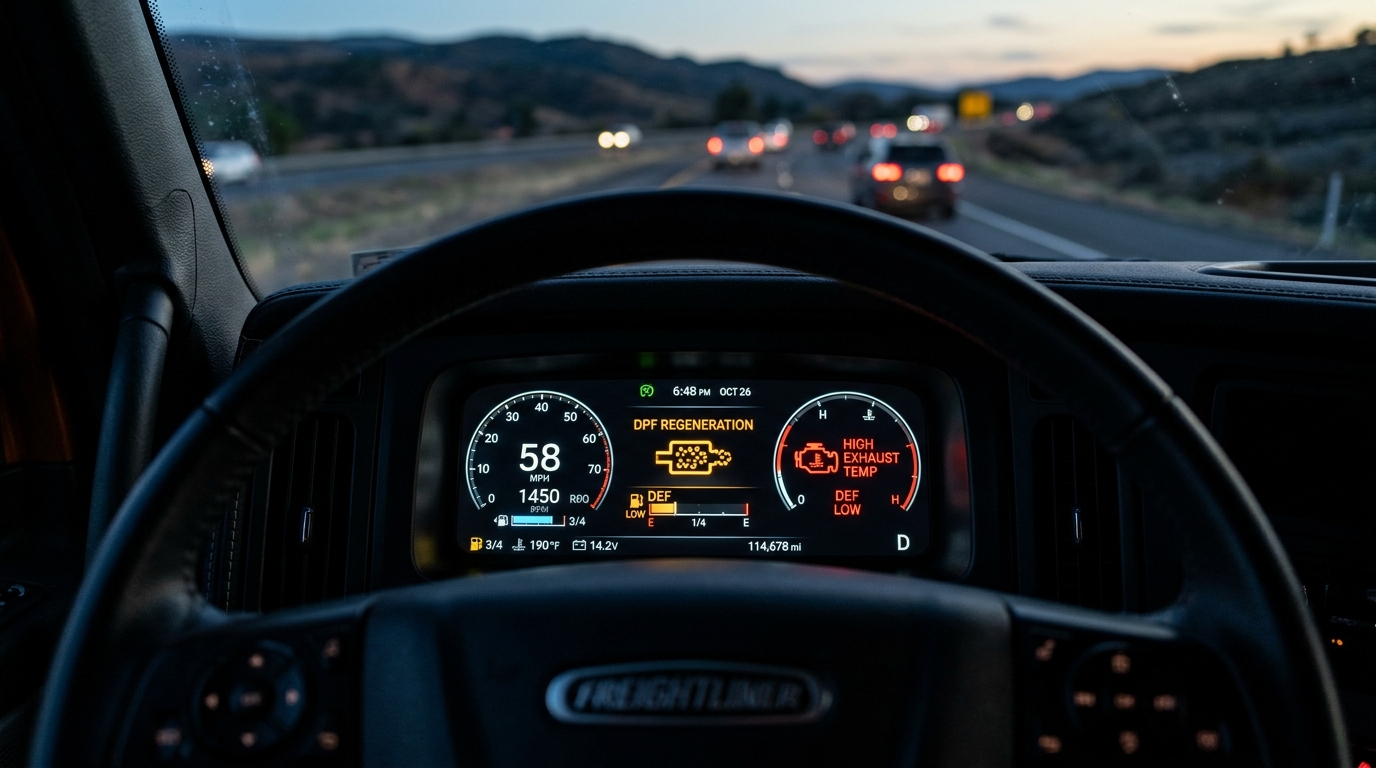
You are hauling a time-sensitive load along Highway 401 toward Toronto or westbound toward London when an amber exhaust icon suddenly illuminates on your dashboard. For commercial truck drivers, independent owner-operators, and fleet dispatchers, this is an immediate high-stress dilemma: Can you push through to complete your delivery, or will continuing to drive trigger an abrupt roadside engine derate?
The short answer: It depends entirely on the status of the warning lamp. Understanding the four critical stages of DPF alert progression is the difference between performing an easy 30-minute parked regeneration and sitting stranded on a highway shoulder waiting for a $1,500 heavy-duty tow truck.
The 4 Critical Stages of DPF Dashboard Warning Lights
Stage 1: Solid Amber DPF Icon
Soot Level: Approximately 80% to 90% full.
Can You Keep Driving? Yes, but with strict caveats. The engine is operating at full horsepower without derate. The ECM is notifying you that normal driving conditions have not provided enough exhaust heat for passive regeneration.
Action Required: If you are on the highway, maintain highway cruise speeds (above 1,500 RPM) for 45 to 60 minutes to enable the ECM to complete an active regeneration. If you are operating in local city traffic or yard shunting, pull into a safe truck stop or terminal within 2 to 4 hours and execute a parked regeneration.
Stage 2: Flashing Amber DPF Icon
Soot Level: Approximately 90% to 105% full.
Can You Keep Driving? No. Continuing to drive will rapidly escalate the system into an irreversible lockdown. At this stage, the ECM begins implementing minor torque derates (10% to 15% reduction in available pulling power).
Action Required: Pull over safely at the nearest commercial truck stop, rest area, or secure yard immediately. Engage the parking brake, set neutral gear, verify that exhaust clear space is safe, and press the dash-mounted Parked Regen switch. Allow the 30- to 45-minute cycle to complete fully.
Stage 3: Flashing DPF + Check Engine Light (Amber)
Soot Level: Greater than 110% full (severe backpressure threshold).
Can You Keep Driving? Strictly limited. The engine is now in severe power derate mode: engine torque is cut by 25% to 40%, and vehicle road speed is capped at 80 km/h (50 mph).
Action Required: In most OEM platforms (Detroit, Cummins, PACCAR), the ECM locks out standard driver-initiated dash parked regens at Stage 3 to avoid uncontrollable exhaust fires. You require diagnostic software to perform a forced service regeneration, or mobile on-site diagnostic assistance from JTECH DPF.
Stage 4: Red STOP Engine Lamp + Audible Alarm
Soot Level: Critical saturation (backpressure exceeding 15 to 20 kPa).
Can You Keep Driving? Absolutely not. The vehicle will enter a 5 mph (8 km/h) limp-home mode or trigger an automated 30-second emergency engine shutdown countdown.
Action Required: Safely maneuver to the shoulder immediately and shut off the ignition. Forcing a parked regeneration at Stage 4 will crack or melt the ceramic core. The filter canister must be removed from the chassis for off-vehicle workshop pneumatic restoration.
The Mechanical Cost of Ignoring DPF Warnings
When drivers attempt to "limp" a truck with a flashing DPF light, the extreme exhaust backpressure causes immediate upstream mechanical destruction:
- Turbocharger Shaft Seal Blowout: High backpressure forces hot exhaust past turbo oil seals, dumping pressurized engine oil into the exhaust stream and ruining the intercooler.
- Ceramic Core Melting: The accumulated soot mass acts as solid fuel. When high-temperature exhaust finally penetrates the core, it triggers thermal runaway, melting the substrate into solid slag ($7,000+ repair).
- Exhaust Manifold Warping: Exhaust gas temperatures trapped in the cylinder head warp cast-iron manifolds and blow out multi-layer steel gaskets.
Understanding SAE J1939 Diagnostic Trouble Codes
When a DPF warning lamp illuminates, the truck’s electronic control unit stores standardized SAE J1939 fault codes that communicate the precise nature of the emissions restriction:
- SPN 3720 / FMI 15 (DPF Soot Load - Least Severe): Signifies that calculated soot loading has exceeded baseline operating levels. The truck can be driven, but active or parked regeneration must take place soon.
- SPN 3251 / FMI 0 (DPF Differential Pressure - High Most Severe): Indicates physical pressure across the filter exceeds safe thresholds, risking turbocharger thrust bearing blow-by. Immediate derate is enacted.
- SPN 3936 / FMI 2 (DPF Pressure Sensor Erratic): Suggests sensor tube condensation, freeze-up, or internal diaphragm fault rather than actual physical soot plugging.
Connecting professional diagnostic hardware at JTECH DPF allows technicians to read these live parameters instantly and clear spurious codes safely.
Frequently Asked Questions
Can an ECM power derate be cleared by disconnecting truck batteries?
No. Modern EPA/Transport Canada emissions regulations require emissions-related derate fault codes to be non-volatile. Disconnecting batteries will not clear active DPF derate codes. The ECM requires a successful diagnostic reset or completion of an authorized regeneration routine.
What should I do if my truck derates on Highway 401 near Kitchener?
Pull off at the nearest commercial truck stop or interchange. Call JTECH DPF dispatch immediately at +1 647-975-1265. Our mobile service van carries commercial diagnostic computers to read active fault codes, assess backpressure, and perform emergency roadside regeneration or dispatch assistance.
Why did my truck derate even though I completed a parked regen yesterday?
If a parked regen clears the light temporarily but the light returns within hours or days, your filter is saturated with incombustible ash. The regen burned off the small layer of soot, but the remaining ash immediately triggers differential pressure trips. The filter requires off-vehicle pneumatic workshop cleaning.
Facing an Active DPF Warning in Southwestern Ontario?
Do not let a warning light strand your truck. Contact JTECH DPF for rapid mobile on-site dispatch or schedule in-shop restoration at our Kitchener emissions hub.
Contact JTECH Emergency Dispatch →